
 By
By 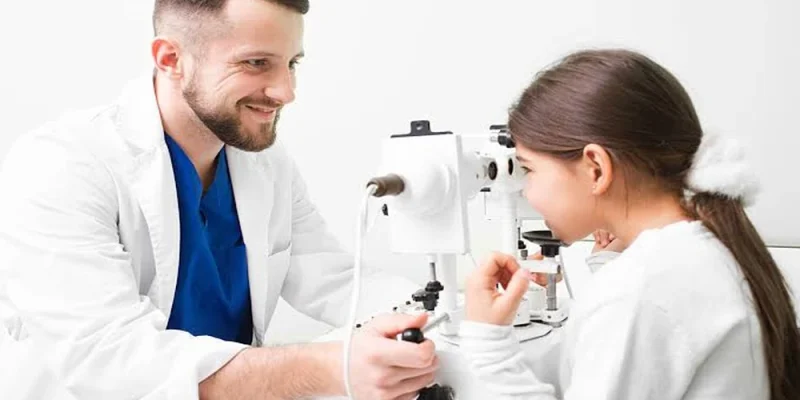
“Is the eye test at the optical shop enough, or should I pay for a full check-up at a clinic?” The honest answer is: it depends on what is being tested. A free power check and a comprehensive examination are very different services, and the price difference reflects the time, equipment and expertise involved. This article breaks down what you get at each level, the indicative price bands across India, and why children in particular need a proper examination on a schedule.
Three levels of “eye test”
Level 1: Vision screening
A quick reading of letters on a chart and an automated refraction (the machine you rest your chin on). Takes five to ten minutes. Often free at optical stores because it leads to a spectacle sale, or a nominal Rs 100 to Rs 300.
What it tells you: approximate glasses power. What it misses: almost everything else.
Level 2: Basic consultation with an eye doctor
Refraction by an optometrist, a slit-lamp look at the front of the eye, eye pressure measurement, and a brief look at the retina. Typically 20 to 30 minutes.
Level 3: Comprehensive examination
Everything in level 2, plus a dilated retinal examination, binocular vision and eye muscle assessment, and tests chosen for your age and risk factors. This takes 45 to 90 minutes and may be split over two visits because dilating drops blur near vision for a few hours. A personalised eye examination of this kind is what doctors mean when they recommend a “full eye check”.
Indicative price ranges across India
Fees differ widely between metros and smaller cities, between standalone clinics and corporate hospitals, and depending on which tests are added. Treat the following as approximate bands, not quotations, and confirm the exact fee with the clinic.
| Service | Approximate cost (INR) |
|---|---|
| Vision screening / automated refraction | Free – 300 |
| Basic consultation (optometrist + doctor) | 300 – 1,000 |
| Comprehensive dilated examination | 800 – 2,500 |
| OCT scan (retina or optic nerve) | 1,500 – 3,500 |
| Visual field test | 800 – 2,000 |
| Corneal topography | 1,500 – 4,000 |
| Dry eye work-up (tear tests, gland imaging) | 500 – 2,500 |
| Children’s examination with cycloplegic refraction | 600 – 2,000 |
So a realistic eye check up cost for a healthy adult with no additional imaging is usually under Rs 2,500 in a metro such as Mumbai, Delhi or Bengaluru, and lower in tier-2 cities. Add Rs 1,500 to Rs 4,000 for each imaging test if your doctor recommends one.
Some clinics quote a single eye test cost that bundles refraction, pressure check and dilation; others itemise. Ask which it is before you book so you can compare like with like.
Does insurance cover it?
Most Indian health insurance policies cover hospitalisation, not routine outpatient examinations. Some newer plans and corporate group policies include an OPD benefit that can be used for eye check-ups and spectacles, usually capped at a few thousand rupees a year. Government schemes such as Ayushman Bharat cover specified eye procedures (for example cataract surgery) rather than routine checks. If you have a corporate policy, check the OPD clause before paying out of pocket.
Why children need a proper examination, not a screening
A child rarely complains of poor vision because they have nothing to compare it with. Conditions that must be caught early include:
- Refractive error (short sight, long sight, astigmatism) affecting school performance.
- Amblyopia (“lazy eye”): the brain ignores one eye. Treatment with glasses, patching or vision therapy works best before the age of seven or eight.
- Squint (strabismus): misaligned eyes that need assessment for both vision and alignment.
- Rarer but serious conditions such as congenital cataract or retinoblastoma, which a dilated examination can detect.
A children’s examination differs from an adult one. The optometrist uses picture or shape charts for pre-readers, checks eye alignment and movement, and uses cycloplegic drops to relax the focusing muscle so the true power is measured. A clinic with a dedicated children’s eye health service will have staff used to working with restless young patients.
How often to get checked, by age
| Age group | Recommended frequency |
|---|---|
| Birth to 1 year | Newborn red-reflex check; again at 6-12 months if risk factors |
| 1 to 5 years | At least once between ages 3 and 5, before school entry |
| 6 to 18 years | Every 1-2 years, or yearly if wearing glasses |
| 19 to 39 years | Every 2 years if no symptoms or risk factors |
| 40 to 59 years | Every 1-2 years (presbyopia, glaucoma screening begins) |
| 60 and above | Every year (cataract, macular degeneration, glaucoma) |
See a doctor sooner, whatever your age, if you have diabetes or high blood pressure (annual retinal check), a family history of glaucoma, high myopia, or any new symptom such as floaters, flashes, pain or sudden blur.
Getting value from the fee
- Ask what is included in the quoted eye check up cost: dilation, pressure check, retina examination, and whether the doctor’s consultation is separate.
- Do not pay for imaging you do not need. OCT and fields are valuable when there is a reason; a healthy 25-year-old usually does not need them.
- Keep your reports. Comparing scans year on year is how glaucoma and macular changes are tracked; a clinic that stores records saves you repeat testing.
- Budget for glasses separately. The examination fee rarely includes frames and lenses, which range from a few hundred rupees to many thousands depending on coatings and design; the clinic’s optical counter can give a separate quote.
Disclaimer: This article is for general information only and is not a substitute for medical advice. Please consult a qualified eye doctor for an examination schedule suited to you and your family.







Comments